This is an optical illusion, I will try to explain with this example:
In the image, there are 12 black dots at the intersections of the gray lines. But the observer cannot see all of them: by focusing on some points, he loses sight of others.
This is because the illusion is based on the characteristics of human vision. Peripheral vision does not see objects very well, so the brain “finishes” the picture where it received little information.
In the case of this picture, the brain decides that around it is the same pattern of gray stripes on a white background and does not notice the black dots.
Any optical illusion based on a static image can work or not work for any person. These pictures are�
they contain duplicate elements that represent conflicting images of light and shadow;
or they reproduce conflicting perspective projections;
or they contain implicit lines, for example, when a contrasting pattern of parallel lines or borders of shapes forces us to complete sloping lines that form a false perspective projection;
or they consist of repeated elements, but the repetitions are not accurate, for example, somewhere the distances between the elements are slightly larger, and somewhere less;
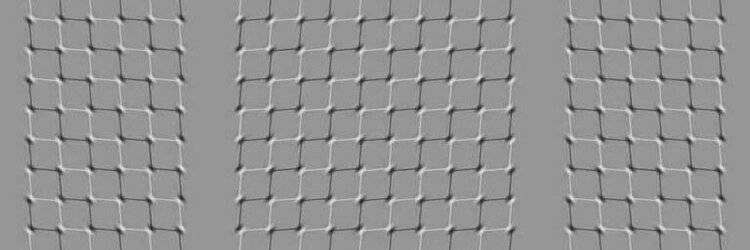
or they combine several of these techniques. With enough attention, you can unravel the technique of a particular image. For example, the one on the cover of the question creates the illusion of movement when changing the viewing angle. If you keep your eyes fixed on one point and the images don't move, the movement will disappear; and if you start moving closer or further away from the screen, the effect will appear. It is less pronounced if you alternately look at the left or right part of the picture, while also changing the viewing angle of the internal squares that contrast with the image texture.
Some images based on the repetition of almost similar elements work especially well when viewed from the side of your eye. A picture appears on the screen, and text appears next to it. As you read the text, you move your gaze. Due to the similarity of the pattern elements (for example, squares), the visual cortex combines the frames fixed by the eye incorrectly. For example, at the first moment squares 4,5,6,7,8 are visible in some area, and at the next moment almost exactly the same 5,6,7,8,9 are visible “in their place”. That is, square 4 turns out to be square 5, etc. Since they are only slightly different from each other, then it seems that their mutual movement has occurred, like when changing frames in a cartoon.
There are also completely static illusions that do not change either when you move your gaze or when you change the viewing angle. These are illusions associated with false highlighting of contrasting lines. One of the main” programs ” of the visual cortex is the selection of lines from a drawing. For example, you can line up identical patterns in a single horizontal line, but inside each one, make a cyclic shift of the pattern by cutting off several pixels from one edge and attaching them from the opposite, and then the visual cortex will select an oblique line from this image. In the example from the cover of the question, the pohizhi effect is created by changing the thickness of the lines of the borders of the squares. Here the squares are perceived as rhombuses due to the alternation of light and dark corners of the squares.
So increase the awareness of the perceived image, test how the picture works: when you quickly move the view from place to place, zoom in/out, tilt. And if it did not work on you initially, then it will certainly work. And in doing so, you will begin to understand exactly how.
This picture belongs to the category of illusion pictures, i.e. when the object in the picture starts moving. If this is not a GIF image, then an interesting question arises: how is this even possible? This phenomenon is called visual deception.�
It's all about our brains. The brain of each person works in its own way, which makes each person have their own perception: some people see movements, others do not. The problem is that the brain doesn't know what to choose when switching between two models of perception — and both models are infallible, because objects can move on their own, or they can stand still.�
What is perception? Perception is a process in the human mind, the process of reflecting objects or phenomena that exist in reality. The case under discussion specifically relates to the psychology of perception — a branch of psychology that studies the process of forming an image of an object in a person's head. To say more: the picture is an optical illusion, the eyes can correctly and incorrectly perceive the position of the object due to the brain, as I wrote in the previous paragraph. To achieve the effect of optical illusion, the image usually has a good background, image depth, and a certain sequence of shapes such as circles or squares(this should be done by a knowledgeable person, just like that it is unlikely to work). In our case, it's more like diamonds.�
It is believed that this technique is used by surrealist artists in their works, trying to deceive the viewer. Visual example:
As for the cover image, the squares are actually stationary.�
Recently, by the way, we discussed the issue of illusions, you can also read it.
I think if everything is in order with the vision and the eye itself, then the picture will “move”in any case. This is an illusion, a kind of visual illusion that works very simply.
The picture moves only in those people who are in neurosis. If you see that the picture is moving, I recommend that you take care of your mental health. This isn't a joke.
Schizophrenics are not affected by optical illusions. Scientists have not yet found out what this is due to, perhaps their brain does not process visual information correctly.
A picture from the category of entertaining physics for preschool age. Such illusions and their perception are well explained there. And there are quite a few examples of such things.
I can only say that if I look.If I look at a plane and I know for sure that the picture can't move, then it doesn't move at all. Perhaps it depends on the type of person.
Personally, I think it's the brain's desire to calculate the distance to an object. If the brain copes with the task, then the picture is static, if it does not cope for any reason(blurred borders, monochrome images, periodic objects), then it moves. From here, if you close one eye, the movement becomes less pronounced.
I have generally converging strabismus, according to the people, one eye is on the other… Sends it. And now the pictures are moving in one eye. Others don't. Just like in the movie with one eye 3D. A: In general, I watch the audience to my right sometimes…. On the left….. 😂😂😂🤣🤣🤣🙆♀️
Everything is much simpler, it's not in the brain, but in the eyes, when you look at a picture, your gaze is fixed on the picture, but you transfer it to different parts of the picture, and then it starts to move, this is natural when moving(even if barely noticeable). But if you fix your gaze at one point and don't move it anywhere, then the picture will be motionless, people just forget that they have two eyes, and each eye sees its own picture, not only from different angles, but also in different ways, but almost no one knows about it, ))
Each person has their own perception. If a person is tired, it seems that the picture moves faster. And if a person is in a calm state, then the movement is not so fast. Well, this picture does not move (this is in my opinion) in thick-skinned people who are calm as a boa constrictor.
Some kind of bullshit, moving pictures… Moving pictures were invented in the 18th century, called cinema. And you, in this age of computers, offer us slides in the filmoscope to watch …
Who sees the green ball? If it only looks at the center. There is an idea of a green ball that slowly rotates shows itself to artists who can immediately detect it.
Personally, I can force myself to see both a moving and static picture, I can make it “vibrate” both in one direction and in the other. I have no idea how it works.
there are no illusions and movement, there is a different focus (distance), lens (lens), pupil and cornea, at each new point of the image (focus guidance), the brain deciphers differently, discrepancies in the readings (error) leads to the feeling that the picture has shifted, there is no deception, there is an inaccuracy in measuring the image with the eye at different points as a result of converting the plane through several “spherical” objects in the eye
This is a simple optical illusion. It's about our brains. He sees the white and black stripes around the pink circles as light and shadow. Because of this, the brain considers them three-dimensional objects. When moving (for example, scrolling through a page with an image), it moves.
I think it's all about how our brain works and what information our eyes send it. I am absolutely healthy( I hope) the picture moves constantly.the artist knows the features of the brain and uses it perfectly.
The more tired or excited a person is, the stronger the effect of such images. I don't know where I got it from. In short, I think it's a matter of mental stress.

This is an optical illusion, I will try to explain with this example:
In the image, there are 12 black dots at the intersections of the gray lines. But the observer cannot see all of them: by focusing on some points, he loses sight of others.
This is because the illusion is based on the characteristics of human vision. Peripheral vision does not see objects very well, so the brain “finishes” the picture where it received little information.
In the case of this picture, the brain decides that around it is the same pattern of gray stripes on a white background and does not notice the black dots.
Any optical illusion based on a static image can work or not work for any person. These pictures are�
With enough attention, you can unravel the technique of a particular image. For example, the one on the cover of the question creates the illusion of movement when changing the viewing angle. If you keep your eyes fixed on one point and the images don't move, the movement will disappear; and if you start moving closer or further away from the screen, the effect will appear. It is less pronounced if you alternately look at the left or right part of the picture, while also changing the viewing angle of the internal squares that contrast with the image texture.
Some images based on the repetition of almost similar elements work especially well when viewed from the side of your eye. A picture appears on the screen, and text appears next to it. As you read the text, you move your gaze. Due to the similarity of the pattern elements (for example, squares), the visual cortex combines the frames fixed by the eye incorrectly. For example, at the first moment squares 4,5,6,7,8 are visible in some area, and at the next moment almost exactly the same 5,6,7,8,9 are visible “in their place”. That is, square 4 turns out to be square 5, etc. Since they are only slightly different from each other, then it seems that their mutual movement has occurred, like when changing frames in a cartoon.
There are also completely static illusions that do not change either when you move your gaze or when you change the viewing angle. These are illusions associated with false highlighting of contrasting lines. One of the main” programs ” of the visual cortex is the selection of lines from a drawing. For example, you can line up identical patterns in a single horizontal line, but inside each one, make a cyclic shift of the pattern by cutting off several pixels from one edge and attaching them from the opposite, and then the visual cortex will select an oblique line from this image. In the example from the cover of the question, the pohizhi effect is created by changing the thickness of the lines of the borders of the squares. Here the squares are perceived as rhombuses due to the alternation of light and dark corners of the squares.
So increase the awareness of the perceived image, test how the picture works: when you quickly move the view from place to place, zoom in/out, tilt. And if it did not work on you initially, then it will certainly work. And in doing so, you will begin to understand exactly how.
This picture belongs to the category of illusion pictures, i.e. when the object in the picture starts moving. If this is not a GIF image, then an interesting question arises: how is this even possible? This phenomenon is called visual deception.�
It's all about our brains. The brain of each person works in its own way, which makes each person have their own perception: some people see movements, others do not. The problem is that the brain doesn't know what to choose when switching between two models of perception — and both models are infallible, because objects can move on their own, or they can stand still.�
What is perception? Perception is a process in the human mind, the process of reflecting objects or phenomena that exist in reality. The case under discussion specifically relates to the psychology of perception — a branch of psychology that studies the process of forming an image of an object in a person's head. To say more: the picture is an optical illusion, the eyes can correctly and incorrectly perceive the position of the object due to the brain, as I wrote in the previous paragraph. To achieve the effect of optical illusion, the image usually has a good background, image depth, and a certain sequence of shapes such as circles or squares(this should be done by a knowledgeable person, just like that it is unlikely to work). In our case, it's more like diamonds.�
It is believed that this technique is used by surrealist artists in their works, trying to deceive the viewer. Visual example:
As for the cover image, the squares are actually stationary.�
Recently, by the way, we discussed the issue of illusions, you can also read it.
I think if everything is in order with the vision and the eye itself, then the picture will “move”in any case. This is an illusion, a kind of visual illusion that works very simply.
The picture moves only in those people who are in neurosis. If you see that the picture is moving, I recommend that you take care of your mental health. This isn't a joke.
Schizophrenics are not affected by optical illusions. Scientists have not yet found out what this is due to, perhaps their brain does not process visual information correctly.
A picture from the category of entertaining physics for preschool age. Such illusions and their perception are well explained there. And there are quite a few examples of such things.
I can only say that if I look.If I look at a plane and I know for sure that the picture can't move, then it doesn't move at all. Perhaps it depends on the type of person.
Personally, I think it's the brain's desire to calculate the distance to an object. If the brain copes with the task, then the picture is static, if it does not cope for any reason(blurred borders, monochrome images, periodic objects), then it moves. From here, if you close one eye, the movement becomes less pronounced.
I have generally converging strabismus, according to the people, one eye is on the other… Sends it.
And now the pictures are moving in one eye. Others don't. Just like in the movie with one eye 3D. A: In general, I watch the audience to my right sometimes…. On the left….. 😂😂😂🤣🤣🤣🙆♀️
Everything is much simpler, it's not in the brain, but in the eyes, when you look at a picture, your gaze is fixed on the picture, but you transfer it to different parts of the picture, and then it starts to move, this is natural when moving(even if barely noticeable). But if you fix your gaze at one point and don't move it anywhere, then the picture will be motionless, people just forget that they have two eyes, and each eye sees its own picture, not only from different angles, but also in different ways, but almost no one knows about it, ))
Each person has their own perception.
If a person is tired, it seems that the picture moves faster. And if a person is in a calm state, then the movement is not so fast.
Well, this picture does not move (this is in my opinion) in thick-skinned people who are calm as a boa constrictor.
Some kind of bullshit, moving pictures… Moving pictures were invented in the 18th century, called cinema. And you, in this age of computers, offer us slides in the filmoscope to watch …
Who sees the green ball? If it only looks at the center. There is an idea of a green ball that slowly rotates shows itself to artists who can immediately detect it.
Personally, I can force myself to see both a moving and static picture, I can make it “vibrate” both in one direction and in the other. I have no idea how it works.
there are no illusions and movement, there is a different focus (distance), lens (lens), pupil and cornea, at each new point of the image (focus guidance), the brain deciphers differently, discrepancies in the readings (error) leads to the feeling that the picture has shifted, there is no deception, there is an inaccuracy in measuring the image with the eye at different points as a result of converting the plane through several “spherical” objects in the eye
This is a simple optical illusion. It's about our brains. He sees the white and black stripes around the pink circles as light and shadow. Because of this, the brain considers them three-dimensional objects. When moving (for example, scrolling through a page with an image), it moves.
I think it's all about how our brain works and what information our eyes send it. I am absolutely healthy( I hope) the picture moves constantly.the artist knows the features of the brain and uses it perfectly.
I can't answer for “someone”. If you focus your eyes on a point, the image doesn't move, but if you don't focus it, it will move. And that's it!
The more tired or excited a person is, the stronger the effect of such images. I don't know where I got it from. In short, I think it's a matter of mental stress.